Milk Glass: The White Glass That Refused to Be Boring
So What Exactly Is Milk Glass?
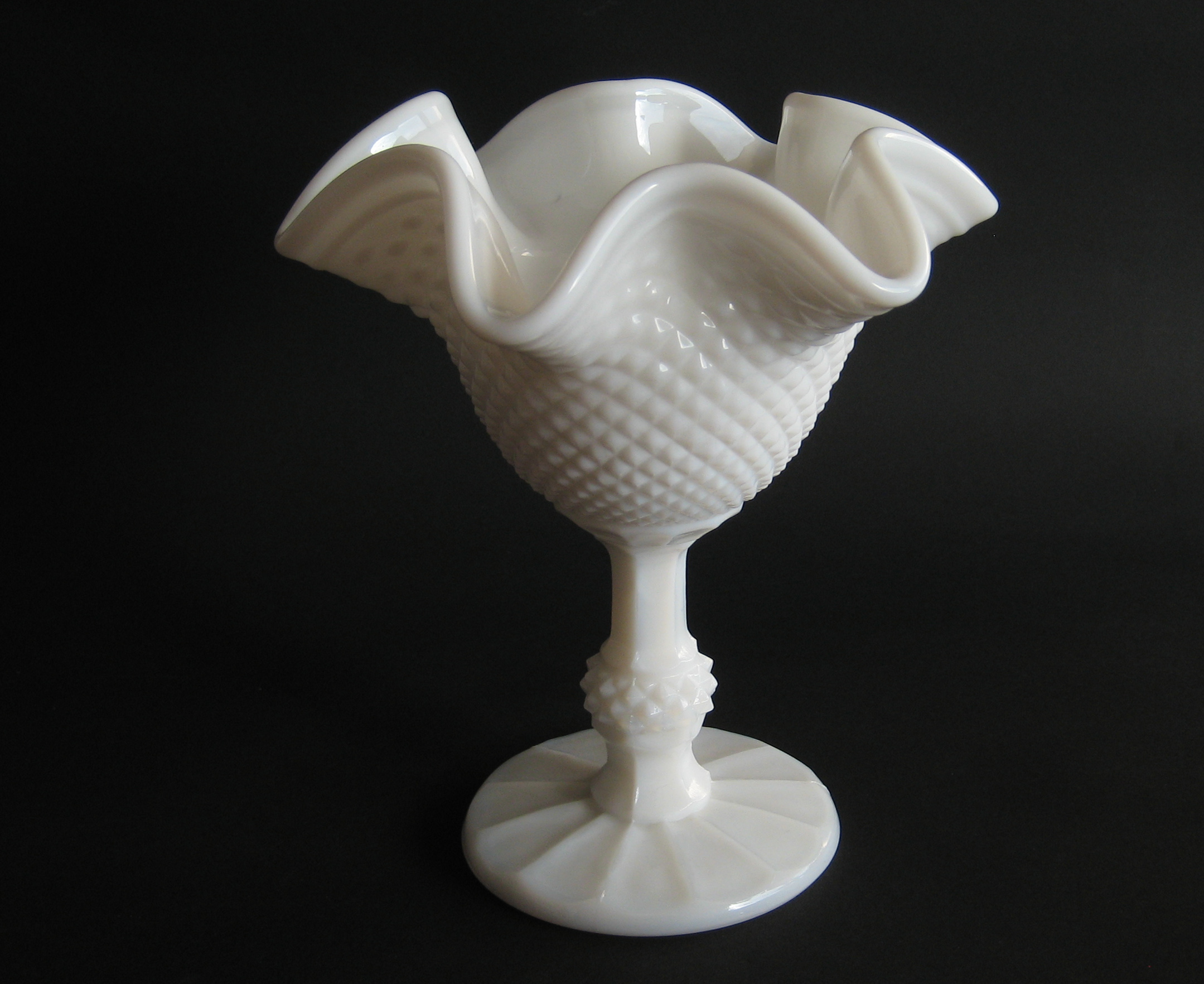
Milk glass is opaque or translucent glass with a milky appearance. White is the color most people picture, but milk glass has also been produced in blue, green, pink, yellow, brown and even black.
The term is often used for glass that looks almost porcelain-like. The Corning Museum of Glass uses the Italian term lattimo, from the word for “milk,” for opaque white glass traditionally made opaque with materials such as tin oxide or arsenic. That porcelain-like look is exactly why milk glass became so popular in the first place.
Milk Glass Is Much Older Than Grandma's China Cabinet
Milk glass is not simply a 1950s decorating fad. Its story reaches back centuries.
European glassmakers were producing opaque white glass long before electricity, department stores or Pyrex ever entered the picture. Venetian glassmakers became known for white lattimo glass, which could imitate the appearance of highly prized porcelain.
That is an important part of the story: milk glass began as a way to create an elegant, luxurious appearance in glass.
By the 1800s, American manufacturers were producing beautiful opaque glass in increasingly elaborate forms. The Corning Museum of Glass, for example, has American milk-glass pieces dating to the nineteenth century, including pressed dishes and decorative tableware.
Then the Victorians Got Involved
And once the Victorians got hold of milk glass, subtlety was no longer a requirement.
Victorian homes loved decoration. If an object could be ruffled, scalloped, beaded, covered in flowers, decorated with grapes or perched on a pedestal, someone was apparently willing to make it.
Milk glass was perfect for this world. It could look refined like porcelain, but pressed-glass manufacturing allowed companies to create detailed shapes and patterns more efficiently.
That meant households could own ornate bowls, compotes, candy dishes, dresser jars, vases, serving pieces, pitchers and covered dishes without purchasing fine imported porcelain.
Some antique milk glass from this period is beautifully delicate. Some of it looks as though the designer was paid by the ruffle.
The Great American Milk Glass Boom
Milk glass became especially associated with American glass companies during the twentieth century.
One of the most important was Westmoreland Glass Company of Grapeville, Pennsylvania. The company was founded in 1889 and began producing opal ware by the early 1900s. According to the National Westmoreland Glass Collectors' Club, Westmoreland's milk-glass production reached its peak during the 1940s through the 1960s. That rich white glass became one of the company's signature products.
This is one reason you still encounter so much milk glass in antique stores today. These companies made a tremendous amount of it, and much of it survived.
The Names Every Milk Glass Hunter Should Know
Westmoreland
If you're going to remember one American milk-glass name, make it Westmoreland.
Westmoreland produced everything from tableware and candy containers to decorative and hand-painted glass. Its white glass became enormously popular with collectors.
The company used several marks during its long history. A well-known later mark is the overlapping WG. Westmoreland adopted the WG trademark in 1946, replacing an earlier Keystone W mark on tableware.
But do not make the rookie mistake of assuming that an unmarked piece cannot be Westmoreland. Marks changed over time, and not every piece carries one.
Fenton
Fenton Art Glass is another major name.
Founded in 1905 by brothers Frank and John Fenton, the company became famous for handmade decorative glass, unusual colors and elaborate patterns. Fenton produced milk glass in many forms, and its hobnail pieces are particularly recognizable.
Traditional glassmaking at Fenton's historic Williamstown, West Virginia, factory ended in 2011, which has only increased collector interest in many older Fenton pieces.
Anchor Hocking and Fire-King
Milk glass also wandered into the kitchen.
Anchor Hocking and its Fire-King lines gave us mugs, bowls, casseroles, restaurant ware and other practical glass pieces that collectors still search for today.
This is where milk-glass collectors and vintage-kitchen collectors begin borrowing each other's shelf space.
Hobnail: The Pattern With Absolutely No Interest in Being Smooth
Hobnail is probably one of the easiest milk-glass styles to recognize.
The surface is covered in rows of raised bumps, giving the glass a highly textured appearance. Hobnail was used on vases, baskets, lamps, bowls, perfume bottles, candleholders and many other decorative pieces.
It is one of those patterns you can often identify from across a room.
If plain white glass is wearing pearls, it's probably hobnail.
Grapes. So Many Grapes.
Milk-glass collectors quickly discover that grape patterns are everywhere.
One of Westmoreland's best-known designs is Paneled Grape. The pattern combines grape clusters, leaves and paneled forms and appeared on a huge variety of pieces.
Once you learn Paneled Grape, you start noticing it everywhere: bowls, pitchers, compotes, covered dishes, plates, goblets and more.
At some point you may begin wondering whether anyone in mid-century America was legally permitted to own a white bowl without grapes on it.
The Hen on Nest
Then there is the hen.
A hen-on-nest is a covered dish shaped like a chicken sitting on a nest. The top is the hen; the bottom is the nest-shaped bowl.
These were made by several glass companies and in many colors, but white milk-glass examples remain especially recognizable.
They were used for candy, food, decoration and possibly as proof that our ancestors were perfectly willing to let a chicken guard the butter.
Today they are highly collectible, and people often build entire collections around animal-shaped covered dishes.
How Do I Know Whether a Piece Is Old?
Here is where milk glass gets interesting.
There is no single test that tells you everything.
You need to become a detective.
1. Turn It Over
Always check the bottom.
Look for molded names, initials, logos, numbers or symbols. Marks can help identify a maker and sometimes narrow down the era.
Possible marks include Westmoreland symbols, Fenton marks, Fire-King markings and other company names.
Also look at the base itself. Is it neatly finished? Does it show mold seams? Is there wear around the bottom from years of use?
2. Look at the Mold Seams
Many pieces of milk glass were pressed in molds.
That means mold lines are not automatically a flaw. They are part of how the piece was manufactured.
Older pressed glass can also show small irregularities, waves or slight variations that came from the manufacturing process.
Perfect does not always mean old. And imperfect does not automatically mean valuable.
3. Examine the Color
Not all milk glass is refrigerator white.
Some pieces are creamy. Some are cool white. Some have a grayish cast. Some appear slightly blue at thinner edges.
The glass formula, manufacturer, thickness and production era can all affect appearance.
Collectors who handle a lot of milk glass eventually develop a strange superpower: they start recognizing certain whites.
4. Hold It Toward the Light
This is one of the fun parts.
Hold the piece toward bright natural light. Some milk glass will remain very opaque, while thinner portions may allow a little light through.
You may notice warmer or cooler tones around rims and edges.
This can provide clues, but do not rely on one “light test” to date a piece. Antique collecting is rarely that cooperative.
Marks Matter — But They Don't Tell the Whole Story
Collectors love maker's marks because they give us something concrete to work with.
But marks can also cause confusion.
For example, Westmoreland changed marks during its long history. The company used a Keystone W mark before adopting its overlapping WG trademark in 1946. After the original company closed in 1984, molds were sold, and some later reproduction glass was made from original molds that still carried Westmoreland markings.
In other words, even a legitimate-looking mark needs context.
This is why serious collectors compare the mark, pattern, color, shape and manufacturing details rather than trusting one feature.
Reproductions: The Milk Glass Plot Twist
Popular antiques eventually develop one predictable side effect:
Somebody starts reproducing them.
Original molds can survive after a company closes. Other manufacturers may purchase those molds and continue making pieces that look very similar to older examples.
Westmoreland is a particularly good example because molds were sold after the factory closed.
This does not necessarily make the later glass unattractive. It simply means that “old-looking” and “old” are not the same thing.
If a seller is asking serious money for a piece, research the exact shape and mark before buying.
What Actually Makes Milk Glass Valuable?
Here comes the answer antique dealers give to almost every value question:
It depends.
Milk-glass value can depend on:
- Maker
- Age
- Pattern
- Rarity
- Color
- Size
- Condition
- Decoration
- Whether all original pieces are present
- Current collector demand
A common mid-century vase may be inexpensive because thousands were produced.
A rare early piece, unusual color, scarce pattern or difficult-to-find form may be worth considerably more.
Condition, Condition, Condition
Check milk glass carefully before buying.
Look for:
- Chips around rims
- Small “flea bites” on sharp edges
- Cracks
- Repairs
- Staining
- Missing lids
- Damage to painted decoration
Ruffled rims are especially worth inspecting because all those lovely little points are basically tiny invitations to chip.
Run your finger carefully around the edge.
Carefully.
Antique research loses some of its charm when it requires a Band-Aid.
About Those Lids
Covered dishes, butter dishes and jars are often more desirable when they still have their correct original lids.
This sounds obvious until you've spent twenty minutes at an estate sale trying to determine whether one lonely lid belongs to any of the six lonely bottoms.
A complete piece is generally more desirable than a mismatched or incomplete one.
Why Is Some Milk Glass So Affordable?
Because a great deal of it was produced.
That is actually one of the reasons milk glass is such a good collecting category for beginners.
You can still find attractive mid-century vases, bowls and serving pieces without spending a fortune.
That means you can learn patterns, manufacturers and shapes by actually handling the glass rather than merely admiring it in reference books.
It's one of the few antique categories where you can sometimes build an impressive display before your family starts asking whether you've taken out a second mortgage.
How to Start a Milk Glass Collection
The easiest method is not to collect everything.
Choose a theme.
For example:
- Hobnail
- Westmoreland
- Fenton
- Paneled Grape
- Animal dishes
- Vases
- Cake stands
- Compotes
- Vintage kitchen pieces
- Only unusual shapes
- Only pieces under a certain price
Or use the oldest collecting strategy in existence:
Buy whatever makes you happy.
It lacks academic rigor, but it has built some excellent collections.
How to Display Milk Glass
One reason collectors love milk glass is that groups of it display beautifully.
Because the pieces share a similar color, you can mix wildly different forms without the display looking chaotic.
A row of white vases in different heights can look striking. Pedestal bowls can add height. Covered dishes create interesting shapes. Small pieces can fill gaps.
Milk glass also makes a fantastic seasonal decorating base.
Spring
Fill milk-glass vases with tulips, daffodils or flowering branches.
Summer
Use pedestal bowls for lemons, berries or garden flowers.
Fall
Pair white milk glass with tiny pumpkins, dried hydrangeas and warm wood tones.
Christmas
Fill compotes with vintage ornaments, greenery or bottlebrush trees.
White glass works with nearly every color palette, which may explain why people who buy one piece occasionally wake up three years later owning forty-seven.
Can You Actually Use Vintage Milk Glass?
Many collectors use their pieces for flowers, decorating and display.
When it comes to food use, be more cautious. Vintage glass can vary widely in composition, age and condition. Pieces with painted or unknown decorative finishes deserve particular care.
If you are unsure about a vintage piece, using it decoratively is the safest option.
Besides, a milk-glass compote piled with antique Christmas ornaments looks considerably more interesting than a bowl of oatmeal anyway.
The Rusty Relics Milk Glass Inspection
The next time you spot a milk-glass piece while treasure hunting, try this:
- Pick it up.
- Turn it over.
- Look for a mark.
- Check the rim for chips.
- Inspect the pattern.
- Look through thinner areas toward the light.
- Check for cracks and repairs.
- If it has a lid, make sure the lid actually fits.
- Decide whether you love it.
Then ask the question every antique hunter eventually learns to ask:
“Am I going to think about this all the way home if I leave it here?”
Because there are two kinds of antique-shopping stories.
There is the story about the treasure you found.
And then there is the story about the thing you didn't buy.
Somehow, the second one gets more expensive every time you retell it.
Milk Glass Quick Guide
What is milk glass?
Opaque or translucent glass with a milky appearance.
Is milk glass always white?
No. White is the most familiar color, but other colors exist.
Important makers?
Westmoreland, Fenton, Anchor Hocking/Fire-King and many others.
Popular patterns?
Hobnail, Paneled Grape, ruffled forms, animal dishes and decorative pressed patterns.
What should I check before buying?
Maker's marks, chips, cracks, repairs, pattern, color, lids and overall condition.
Does old automatically mean valuable?
No. Rarity and collector demand matter just as much.
Is unmarked milk glass worthless?
Absolutely not. Many legitimate older pieces are unmarked.
Best reason to collect it?
Because you like it.
Final Thought
Milk glass is one of those antiques that rewards curiosity.
At first it looks simple: a white bowl, a white vase, a funny little chicken.
Then you begin noticing makers, marks, molds, patterns, eras and subtle differences in the glass itself.
Before long, that plain white vase is no longer just a vase. It is a clue to an American factory, a design trend, a manufacturing technique and the people who owned it before you.
And that is the fun of antiques.
The object is only the beginning of the story.